
You have probably never heard of CHO cells unless you work in biologics or global drug manufacturing. CHO stands for Chinese hamster ovary, and these cells are used to produce nearly 70 percent of approved recombinant therapeutic proteins.[1] In practical terms, one obscure cell platform now underpins a biologics market worth roughly $400 billion globally.[2]
The drugs CHO cells produce are not obscure. Humira, Herceptin, Avastin, and Keytruda — among the best-selling biologics in pharmaceutical history — are all manufactured using CHO cell expression systems. Virtually every approved monoclonal antibody, most fusion proteins, and a significant share of clotting factors used in clinical medicine today pass through CHO cell culture at some point in their production.[1]
The origin story borders on improbable. Modern CHO cell lines trace back to a small colony of Chinese hamsters transported from Beijing to the United States in the 1940s. In 1957, Theodore Puck at the University of Colorado established the first immortalized CHO cell line from that lineage. Over the following decades, researchers discovered that CHO cells could be engineered to produce complex human proteins with the correct three-dimensional folding and glycosylation patterns required for therapeutic use — a property most other easily cultivated cell types lack. Descendants of that original colony now underpin a significant share of the global biologics industry.[3]
Despite how obscure this all sounds, the larger story is not really about hamster cells at all. It is about the global industrial ecosystem that formed around them.
The Infrastructure That Built Up Around a Cell Line
For decades, biologics development evolved through fragmented handoffs between discovery groups, process development teams, contract manufacturers, clinical operators, and regulatory bodies. A company might spend years and hundreds of millions of dollars moving a biologic from a stable cell line into a clinical-grade manufacturing process — and then face further delays navigating the analytical testing, comparability studies, and regulatory submissions required to maintain supply continuity.
Chinese biologics companies recognized earlier than many expected that speed in biologics increasingly comes from reducing the distance between those functions, not optimizing them independently. Rather than positioning purely as contract manufacturers executing discrete steps, leading Chinese CDMOs and CROs began integrating discovery, cell line engineering, process development, clinical manufacturing, and regulatory support under coordinated platforms.
The scale of the resulting systems is becoming difficult to ignore. WuXi Biologics reported 945 integrated client projects in 2025 and more than 1,300 delivered cell lines through its proprietary WuXia CHO platform.[4][5] Those figures reflect more than manufacturing growth. They point to the emergence of tightly integrated biologics development ecosystems designed to move therapies from cell line engineering into clinical manufacturing and commercial production with less friction at each step.
China is no longer positioning itself simply as a manufacturing base inside global biotech. Companies like WuXi Biologics, Legend Biotech, and BeOne Medicines are increasingly embedded in multinational clinical trials, licensing agreements, global supply chains, and international commercialization efforts. In biologics and advanced therapeutics, where products move directly into patients and regulatory systems are globally interconnected, credibility matters as much as speed.
China's biotech sector increasingly understands that long-term influence in global drug development depends not only on scale and efficiency, but also on the importance of using proven and trusted quality systems and software, regulatory alignment, and international credibility.
China's speed in biologics increasingly comes from tighter integration across development, manufacturing, and clinical execution, even as regulatory expectations and quality standards continue to rise internationally.
What Integration Creates
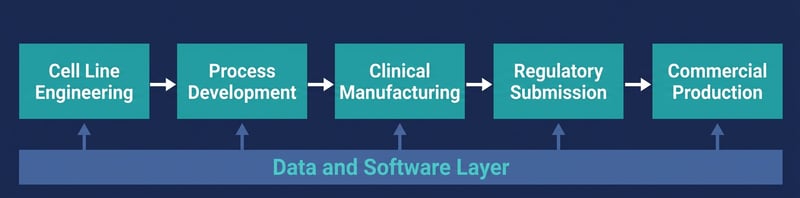
Tighter integration across development functions is not only an operational achievement. It also generates something that increasingly defines competitive advantage in biologics: dense, interconnected data across organizational boundaries.
Cell line genealogy and stability records generated during development need to connect to process performance data in manufacturing. CMC packages assembled for one regulatory jurisdiction must be adapted for another. Clinical data generated by CRO partners must be harmonized with sponsor records before submission. The faster these handoffs happen — and the more reliably they happen — the faster the overall program moves.
Software and data infrastructure capable of supporting those handoffs is not a peripheral addition to the integrated biologics model. It is increasingly foundational to how integrated programs function and how they demonstrate credibility to global regulatory bodies, global partners, and the pharmaceutical companies evaluating Chinese assets.
One hamster cell lineage quietly became foundational to modern medicine. Now the infrastructure surrounding that lineage is reshaping how biologics are developed: more integrated, more global, and increasingly built around ecosystems that connect discovery, manufacturing, clinical execution, and the data and software platforms that coordinate it all.
What This Means for China Market Entry
Three questions worth answering before selling software or data tools into China's integrated biologics ecosystem:
-
Map your buyer to a development function. The integrated biologics ecosystem is not a single buyer. A software product supporting cell line tracking and stability data management finds its natural buyer in a process development or cell biology team. A platform managing CMC documentation and regulatory submissions belongs in a quality and regulatory affairs conversation. A tool improving data transfer between CRO partners and sponsors lives in clinical operations. The market intelligence required to find and qualify each buyer type differs — a single messaging approach misses most of the market.
-
Follow the data handoffs. The highest-value problems in integrated biologics development sit at the boundaries between organizations: where CRO-generated data needs to be interpretable by a sponsor, where process development records need to connect to manufacturing comparability studies, where clinical data must align across jurisdictions before regulatory submission. Products that solve handoff problems become structurally embedded in the programs that run through them.
-
Lead with regulatory credibility, not efficiency. Integrated programs in China increasingly run under international regulatory scrutiny — NMPA, FDA, and EMA submissions may run concurrently. Software that leads with audit traceability, data integrity, and regulatory-grade record keeping has a fundamentally different conversation than software that leads with time savings. In a regulated manufacturing environment, the argument that earns a meeting is not "this is faster." It is "this is what your regulator will trust."
Sources:
[1] Recombinant protein production in CHO cells. National Library of Medicine. https://pmc.ncbi.nlm.nih.gov/articles/PMC10824870/
[2] Global biologics market size. Grand View Research. https://www.grandviewresearch.com/horizon/outlook/biologics-market-size
[3] Chinese hamster ovary cell. Wikipedia. https://en.wikipedia.org/wiki/Chinese_hamster_ovary_cell
[4] WuXi Biologics 2025 annual results press release. https://www.wuxibiologics.com/press-release/wuxi-biologics-reports-record-2025-annual-results-operational-excellence-driven-by-digital-native-architecture/
[5] WuXi Biologics 2025 full annual report. https://www.wuxibiologics.com/wp-content/uploads/2025res.pdf